
UK: PPDS (Natasha’s Law) and allergens in bold in the ingredients
Since 1 October 2021, food that a business packs on its own premises before the customer orders it — a sandwich, a salad or a slice of cake wrapped at the counter — must carry its name and a full ingredients list. Each of the 14 allergens has to stand out every time it appears in that list. The rule is known as Natasha’s Law.
- Law
- UK Government — Food Standards Agency (FSA) guidance
- United Kingdom — food prepacked for direct sale (PPDS)
What the regulation requires
- Name of the food (Food Information Regulations 2014, reg. 6A).
- Full list of ingredients, in descending order of weight (reg. 5A).
- The 14 allergens emphasised every time they appear in the ingredients list — in bold, for example (Art. 21 of Regulation 1169/2011 as it applies in the UK).
- Cereals containing gluten and tree nuts named by their type: “wheat”, “almond”, not just “gluten” or “nuts” (FSA guidance).
Time limits and temperatures
- PPDS sets no storage times: the use-by date comes from the business’s own food safety assessment (HACCP).
SI 2019/1218 applies in England; Wales, Scotland and Northern Ireland have equivalent rules in force on the same date. It covers food packed before it is ordered and sold on the same premises (or from the same business’s market stall or van). Food packed at the customer’s request is not PPDS, and food prepacked by another business needs full labelling.
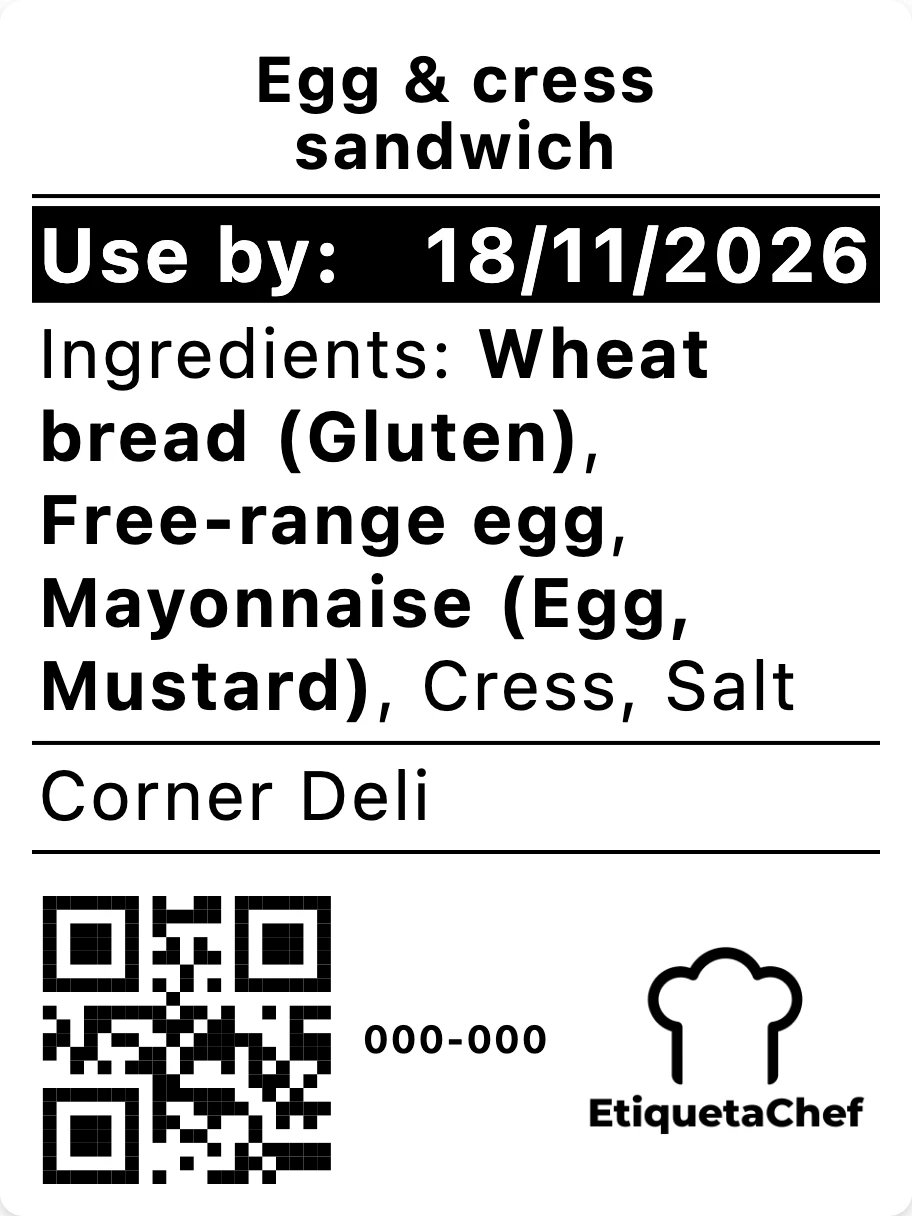
The label fields
These are the fields EtiquetaChef prints for this regulation.
- Product name Required by the regulation
- Use by Good practice
- Ingredients Required by the regulation
- Establishment Good practice
How to set it up in EtiquetaChef
- In the template editor, create a template in the size of your label roll.
- Turn on the fields listed above and save the template.
- When you print, choose that template: the use-by date is calculated from the product’s rule.
Official text of the regulation · Text checked on November 1, 2026
The template is designed for this regulation, but label compliance remains the responsibility of the establishment and its food safety lead. Always check the version of the regulation currently in force.
Other regulations
- RDC 216/2004 — Brazil — food services
- CVS 3/2026 (SP) — Brazil — state of São Paulo
- FDA Food Code — United States — where the state or county has adopted the Food Code
- Reg. (EU) 1169/2011 and 852/2004 — The 27 European Union countries
- Italy — HACCP — Italy
- Arrêté of 21/12/2009 — France — food retail and catering
- RD 1021/2022 — Spain — food retail and catering
- Codex CXC 39-1993 — International — recommendation
- FSANZ Standard 3.2.2A — Australia — food service, catering and retail
- SFA time stamp (consume by) — Singapore — licensed caterers
Frequently asked questions
What counts as PPDS food?
Food packed on the same premises where it is sold, before the customer chooses it: sandwiches, salads, pies, cakes or bread packed in the morning and left in the display. Food packed only after the customer orders is not PPDS.
How does EtiquetaChef put the allergens in bold?
In the product, mark which ingredient contains each allergen (“Allergens in each ingredient”). In the template, turn on “Allergens in bold within ingredients”. The marked ingredient prints in bold, with the allergen in brackets when its name does not mention it — “Wheat bread (Gluten)”. An allergen not marked on any ingredient prints in bold at the end of the list.
Do I need a separate “Contains” or “Allergy advice” line?
No. With an ingredients list, the FSA guidance says the allergen information must be given in the list, emphasised — a separate line does not replace it. That is why the PPDS template prints only the list, with no allergen line.
Ready to stop wasting product?
Talk to a consultant and put together the right plan for your kitchen.
Talk to a consultant