
Australia: FSANZ Standard 3.2.2A and the kitchen label
Since December 2023, Standard 3.2.2A of the Food Standards Code applies to Australian businesses that handle unpackaged, ready-to-eat, potentially hazardous food: caterers, restaurants, cafés, takeaways, pubs, supermarkets and delis. Category one businesses must keep records, or show in another way, that they control how that food is received, stored, processed, displayed and transported, and how they clean and sanitise.
- Law, no fields defined
- Food Standards Australia New Zealand (FSANZ)
- Australia — food service, catering and retail
What the regulation requires
- Category one (makes unpackaged, potentially hazardous food ready to eat on site): Food Safety Supervisor, trained food handlers and evidence that the critical controls are met (Standard 3.2.2A).
- Category two (sells that food unpackaged without making it on site): Food Safety Supervisor and trained food handlers.
- Potentially hazardous food stored at 5 °C or colder, or at 60 °C or hotter (Standard 3.2.2).
Time limits and temperatures
- Unpackaged, ready-to-eat, potentially hazardous food: generally no more than 5 days in the fridge; with raw or lightly cooked egg, generally no more than 24 hours (FSANZ guidance).
- 2-hour/4-hour rule (FSANZ guidance): less than 2 hours out of safe temperature (between 5 °C and 60 °C), the food can go back in the fridge; between 2 and 4 hours, use or sell it but do not refrigerate it again; more than 4 hours, throw it away.
Standard 3.2.2A sets management tools and evidence, not the fields of the internal kitchen label. A label with the preparation date and the use-by date is a practical way to show the authorised officer of your state or territory how you control storage time. These Chapter 3 standards apply in Australia, not in New Zealand.
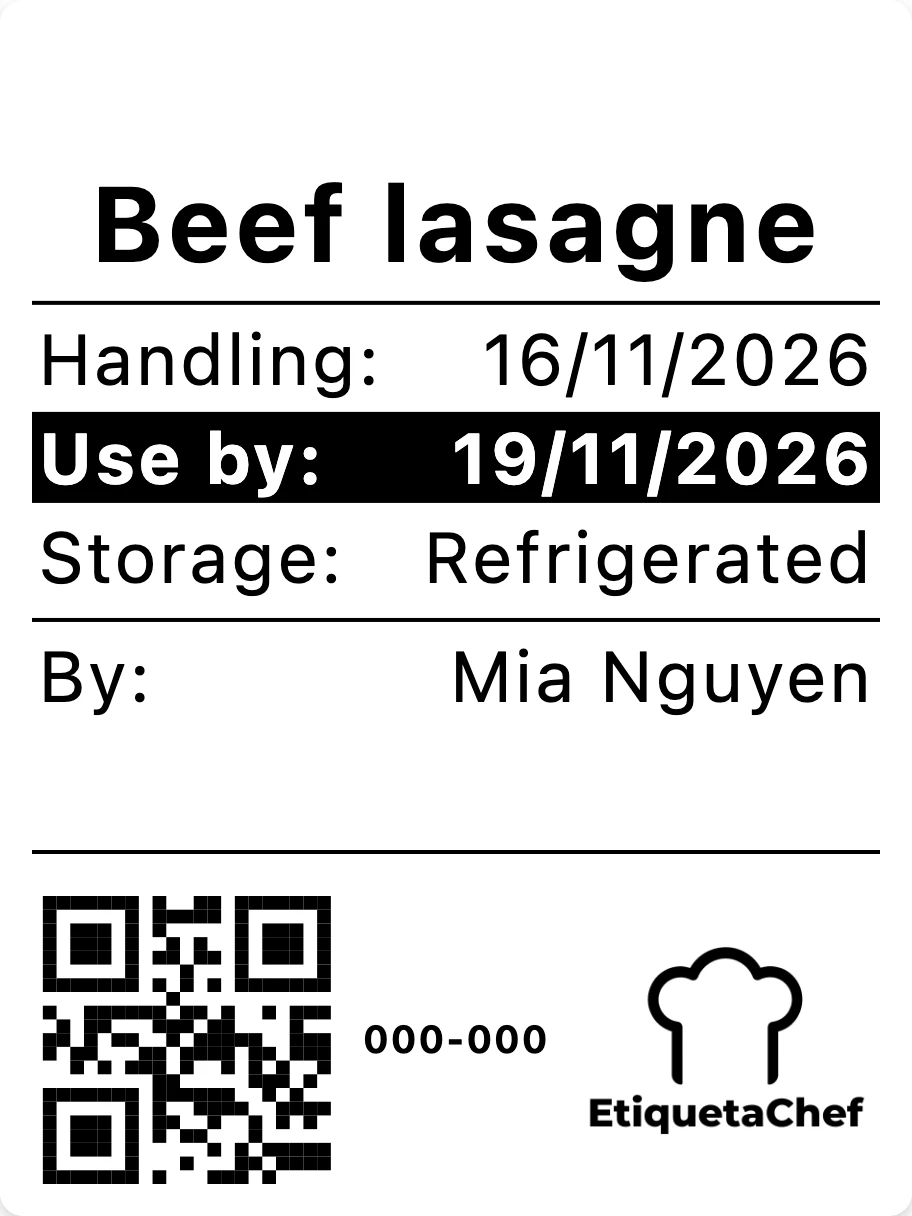
The label fields
These are the fields EtiquetaChef prints for this regulation.
- Product name Good practice
- Handling (preparation or opening date) Good practice
- Use by Good practice
- Storage Good practice
- Responsible Good practice
How to set it up in EtiquetaChef
- In the template editor, create a template in the size of your label roll.
- Turn on the fields listed above and save the template.
- When you print, choose that template: the use-by date is calculated from the product’s rule.
Official text of the regulation · Text checked on November 22, 2026
The template is designed for this regulation, but label compliance remains the responsibility of the establishment and its food safety lead. Always check the version of the regulation currently in force.
Other regulations
- RDC 216/2004 — Brazil — food services
- CVS 3/2026 (SP) — Brazil — state of São Paulo
- FDA Food Code — United States — where the state or county has adopted the Food Code
- Reg. (EU) 1169/2011 and 852/2004 — The 27 European Union countries
- Italy — HACCP — Italy
- Arrêté of 21/12/2009 — France — food retail and catering
- RD 1021/2022 — Spain — food retail and catering
- PPDS (Natasha’s Law) — United Kingdom — food prepacked for direct sale (PPDS)
- Codex CXC 39-1993 — International — recommendation
- SFA time stamp (consume by) — Singapore — licensed caterers
Frequently asked questions
Does Standard 3.2.2A say what goes on the kitchen label?
No. It requires you to show that you control the critical steps: receiving, storage, processing, display and transport, plus cleaning and sanitising. Labelling each container with the preparation and use-by dates keeps part of that evidence on the food itself.
Is my business category one or category two?
Category one makes unpackaged, potentially hazardous food ready to eat on site and serves it without further processing: caterers, restaurants, cafés. Category two only sells that food, handled unpackaged but not made on site, at most slicing, weighing, repacking, reheating or hot-holding it.
Does EtiquetaChef time the 2-hour/4-hour rule?
No. The label shows when the food was prepared and until when it can be used. Time out of safe temperature is still tracked by the team, as the FSANZ guidance describes.
Ready to stop wasting product?
Talk to a consultant and put together the right plan for your kitchen.
Talk to a consultant