
HACCP labelling system: what it is and what the label needs
A HACCP labelling system is the set of rules, label templates and printing routine that turns the time controls of your HACCP plan into a label on every container: product, prep date and time, use-by date, storage and the person responsible. It makes the critical limit visible on the shelf and leaves a record an inspector can check.
- HACCP
- Hazard Analysis and Critical Control Points
- CCP
- Critical Control Point
- FEFO
- First Expired, First Out
The 7 HACCP principles and where the label comes in
HACCP is a method, defined by the Codex Alimentarius, with seven principles. The label does not replace the plan, but it is the piece of evidence that shows up in six of them.
| Principle | In the kitchen | Role of the label |
|---|---|---|
| 1. Hazard analysis | List what can go wrong at each step: bacteria growing in a cooked sauce, an allergen getting into the wrong dish. | None directly: this is the plan. |
| 2. Critical control points | Pick the steps where the hazard is controlled: cooling, cold holding, thawing, reheating. | Cold holding and shelf life after opening or prep become label rules. |
| 3. Critical limits | Set the number for each point: for example, 3 days at 0–5 °C after prep. | The use-by date printed on the label is the critical limit applied to that container. |
| 4. Monitoring | Check, at a set frequency, that each point is within its limit. | Anyone checks the shelf by reading the date, without asking who prepped it. |
| 5. Corrective actions | Decide what to do when a limit is missed: discard, re-cook, re-label. | An expired label is the trigger: the item is discarded and the discard is recorded. |
| 6. Verification | Confirm the system works: internal audits, checks by the manager. | Labels read the same for everyone, so a sample check takes minutes. |
| 7. Documentation and records | Keep the plan and the records that prove it was followed. | Each label printed is a record: what, when, until when and who. |
What makes a labelling system, not just a label
A label on its own is a sticker. It becomes a system when four parts work together and the team cannot skip any of them.
-
Shelf-life rules per product and situation
Each product has its shelf-life rules, one per situation (sealed, opened, prepped, thawed, cooked), taken from your HACCP plan. Nobody calculates dates in their head.
-
One template per label type
The same fields in the same place on every label, so the team and the inspector know where to look.
-
Printing at the moment of handling
The label is printed when the container is opened or prepped, not at the end of the shift from memory.
-
Record and history
What was labelled, when and by whom stays recorded, including what was discarded, so the control can be shown later.
Which fields a HACCP label needs
HACCP does not fix a label layout: the fields come from your plan and from the food rules of your country. These are the ones a kitchen label usually needs.
- Product name What it is, without guessing from the colour of the sauce.
- Storage Refrigerated, frozen or room temperature: where the container has to stay.
- Prep or opening date and time The starting point of the time control.
- Use-by date (and time, for short rules) The critical limit applied to that container, already calculated.
- Person responsible Who handled it, so questions have someone to go to.
- Batch or allergens, when they apply Traceability back to the supplier and allergen information for the dish.
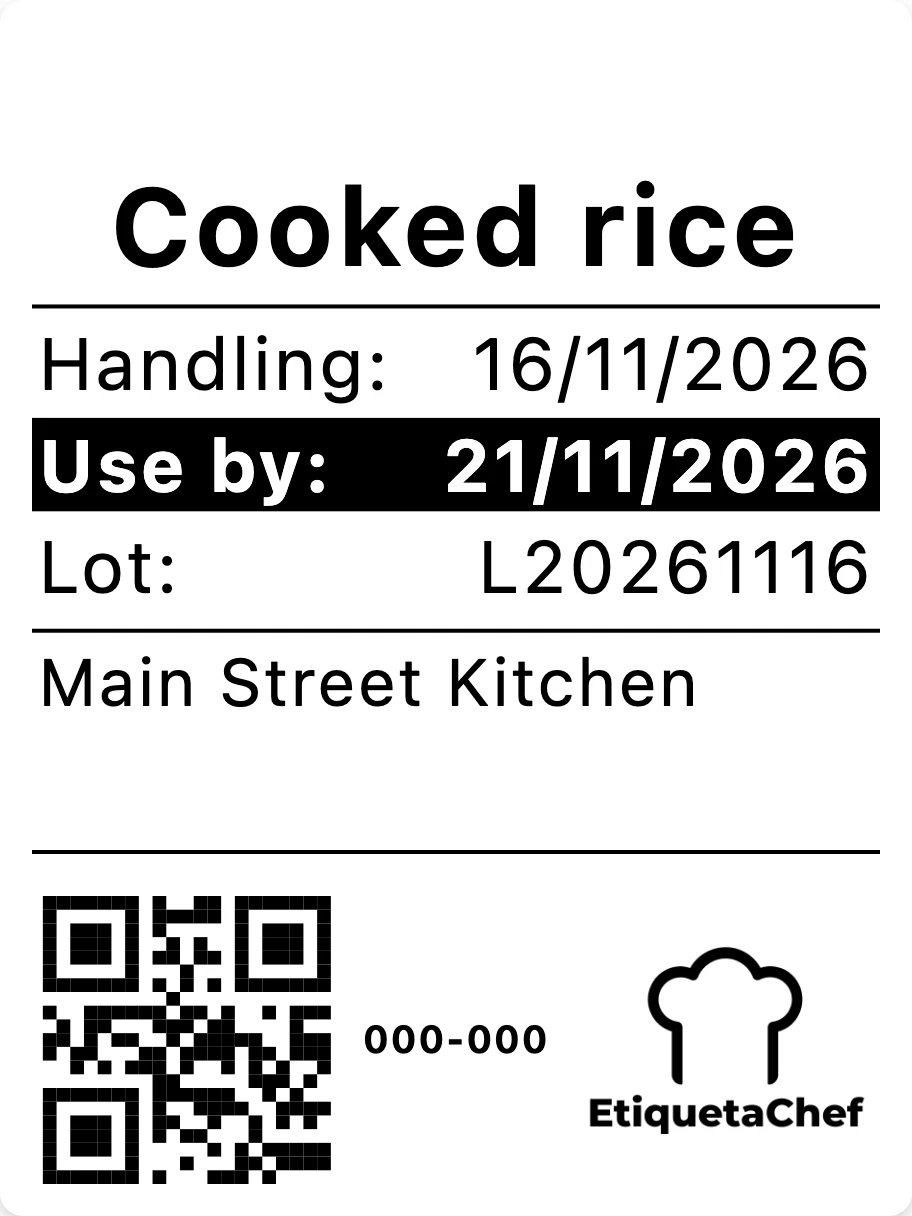
Tape and marker vs labelling system
| Aspect | Tape and marker | Labelling system |
|---|---|---|
| Use-by date | Calculated in someone’s head, every time | Calculated from the product rule |
| Legibility | Smudges, peels, depends on handwriting | Printed, same layout on every label |
| Same rule for everyone | Each cook applies their own | The rule is in the system, not in memory |
| Record | None once the tape goes in the bin | Labels and discards stay in the history |
| Inspection | Hard to show what was controlled | Labels and history are there to show |
How to set up a HACCP labelling system, step by step
-
Start from the plan
- List the products that are opened, prepped, thawed or cooked in the kitchen.
- For each one, write the shelf life per situation (opened, prepped, thawed…), as defined in your HACCP plan.
- Check the rules that apply in your country (see the label rules by country).
-
Define the label
- Choose the fields: product, prep date, use-by date, storage, person responsible.
- Add batch and allergens where your plan or the law asks for them.
- Use one template per type, so every label looks the same.
-
Put it into the routine
- Label at the moment of opening or prepping, before the container goes into the fridge.
- Store by expiry: what expires first goes in front (FEFO).
- Check the shelves at the start of each shift and discard what is past its date.
-
Keep the records
- Record what was discarded and why.
- Review the rules when the menu or a supplier changes.
- Train new staff on the routine, not just on the printer.
Common mistakes
- Using the manufacturer’s date after the pack is opened.
- Labelling at the end of the shift, from memory.
- Different shelf lives for the same product depending on who prepped it.
- Labels without the person responsible, or without the time when the rule is in hours.
- Treating the label as a temperature record: it shows time, the fridge still needs its own checks.
Checklist for a label that works as a HACCP record
- Identifies the product without guesswork
- Shows the prep or opening date
- Shows the use-by date, already calculated
- Names the person responsible
- Is legible and survives the kitchen routine
- Follows the same template as every other label
How EtiquetaChef handles HACCP labels
In EtiquetaChef each product carries its shelf-life rules, one per situation. You pick the product and the rule, the app calculates the use-by date and prints the label on a Bluetooth thermal printer from Android, iPhone or iPad. The web panel manages products, rules and the label history. The app records who printed each label, keeps current labels separate from history and shows what expires today. Allergens from the product sheet print in bold. The rules themselves come from your HACCP plan: the app applies them the same way every time.
This is an operational guide, not legal advice. Shelf lives and label rules depend on your HACCP plan and on the law of your country.
Read also
HACCP labelling: frequently asked questions
What is a HACCP labelling system?
It is the combination of shelf-life rules, label templates and a printing routine that puts the time controls of a HACCP plan on every container, and keeps a record of what was labelled.
Does HACCP require labels?
HACCP requires you to control critical points and keep records. It does not prescribe a label, but in a kitchen the date label is the most common way to control shelf life and show that control. Many national rules do ask for a label: check the ones for your country.
What information goes on a HACCP label?
Product name, prep or opening date and time, use-by date, storage and the person responsible. Batch and allergens when your plan or the law asks for them.
Is a handwritten label enough for HACCP?
It can be, if it is legible, complete and always made the same way. In practice handwriting smudges, the date is calculated differently by each person, and nothing is left on record once the tape is thrown away.
What is a critical control point in a kitchen?
A step where a hazard is controlled and a limit can be checked: cooking, cooling, cold holding, thawing, reheating. Cold holding is one of the most frequent, and the shelf life after opening or prep is its critical limit.
How long should HACCP records be kept?
It depends on your country and on the product. A common practice is to keep them at least for the shelf life of the product plus a margin; check the rule that applies to you.
Does a labelling system replace the HACCP plan?
No. The plan identifies the hazards and sets the control points and the limits. The labelling system applies those limits to each container and records it.
Ready to stop wasting product?
Talk to a consultant and put together the right plan for your kitchen.
Talk to a consultant