
FIFO and FEFO in the kitchen: what they are and how to apply them
FIFO (First In, First Out) and FEFO (First Expired, First Out) are the two stock rotation rules of a kitchen. FIFO orders food by arrival and fits sealed stock with the same use-by date; FEFO orders it by expiry and applies to batches with different dates and to anything opened, prepped, thawed or cooked.
- FIFO
- First In, First Out
- FEFO
- First Expired, First Out
- LIFO
- Last In, First Out
What FIFO solves
-
Food safety
An opened or prepped ingredient has a short shelf life. If it sits behind a newer one, it goes past its limit without anyone noticing.
-
Waste and food cost
What goes past its limit goes in the bin, and what goes in the bin was bought, received, stored and sometimes prepped. It is lost food cost that no report shows until someone counts it.
-
No equipment needed
FIFO needs no equipment and no budget. It needs discipline, and discipline only holds when the date is visible at the moment of the gesture.
FIFO vs FEFO vs LIFO: what is the difference
All three are ways to decide which container leaves the shelf first. What changes is the criterion: arrival date or expiry date.
| Rule | Orders by | In the kitchen |
|---|---|---|
| FIFO | Arrival date | Sealed stock with the same use-by date on every batch: the oldest goes first. |
| FEFO | Expiry date | Batches with different dates, and everything opened, prepped, thawed or cooked. |
| LIFO | Last arrival | Never used for perishable food: the oldest stays at the back and expires. |
Arrival date is not the expiry date
| Situation | What decides | Rule |
|---|---|---|
| Sealed, same date on both batches | The delivery date | FIFO |
| Sealed, different dates | The date printed by the manufacturer | FEFO |
| Opened, prepped, thawed or cooked | The shelf life set by the house rule | FEFO |
The manufacturer’s use-by date only applies to the unopened pack. Once opened, the shelf life that counts is the one your food safety plan sets for that state — in the US, the FDA Food Code asks for date marking on ready-to-eat food held for more than 24 hours.
FEFO: first expired, first out
FEFO is not another name for FIFO. FIFO asks "what arrived first?"; FEFO asks "what expires first?". Most of the time the answer is the same, and it is exactly when it is not that FIFO sends the wrong batch to the line while the other one expires on the shelf.
When arrival misleads: two batches of cream
Batch A arrived first, but from a supplier with a fresher production run. Batch B arrived later, from older distributor stock.
| Batch | Arrived | Use by | By FIFO | By FEFO |
|---|---|---|---|---|
| A | 3 March | 30 March | Goes first | Goes later |
| B | 5 March | 12 March | Goes later | Goes first |
Following FIFO, the kitchen uses batch A and batch B expires on the 12th, still sealed. Following FEFO, B is used first and neither ends up in the bin. The same logic applies to what the kitchen preps: a sauce made today that lasts 1 day goes before a base made yesterday that lasts 3 days.
When FEFO decides
- Batches of the same product with different use-by dates, even if they arrived in the "right" order.
- Anything opened, portioned or prepped: the shelf life becomes the house rule, not the manufacturer’s date.
- Thawed and cooked food, which gets its own short shelf life.
- Intermediate preps (sauces, bases, mise en place) made on different shifts.
How to apply FEFO
- Every label shows the use-by date prominently; the arrival date comes second.
- On the shelf, order by expiry: what expires first sits in front, even if it arrived later.
- The daily round checks expiry ("expires today / tomorrow"), not the delivery date.
- A delivery with a shorter date than current stock goes to the front when it is put away.
How to apply FIFO station by station
-
At delivery
- Check the date and condition of every case before putting it away.
- Label before storing, not after service: a portioned ingredient without a label is an ingredient without a date.
- Reject what arrives with a shelf life too short to be used.
-
In the walk-in and the dry store
- New stock goes behind or below; old stock stays in front or on top.
- One zone per state: sealed, opened, in prep.
- The date must be readable without moving the container.
-
During service
- Always take from the front. If the front one is not the oldest, the problem is how the shelf was stocked.
- Anything taken out and not used goes back to its own place, not the first empty gap.
-
Every day
- Run a "use today / use tomorrow" check before prep.
- Write down what was thrown away: without that number you cannot tell whether FIFO works.
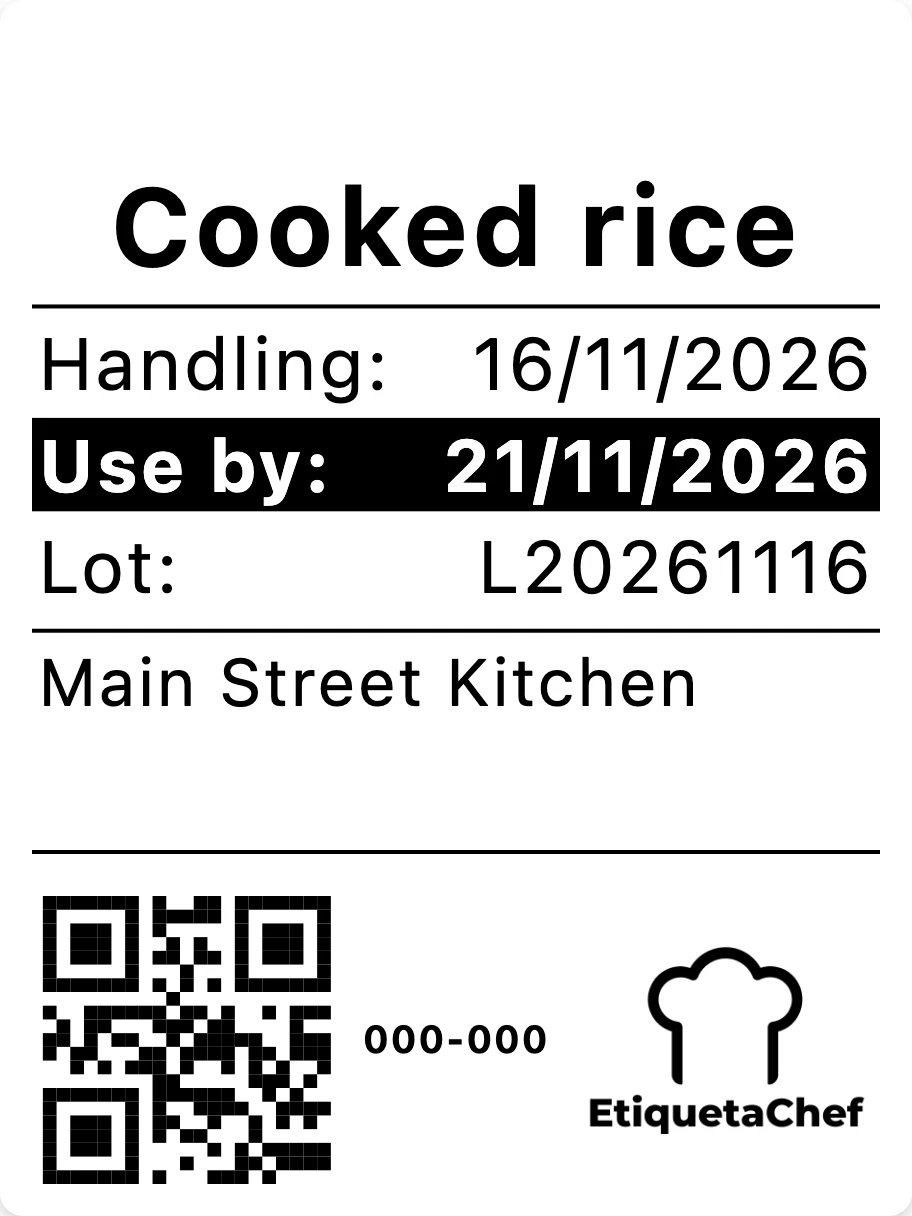
What a FIFO food label must show
FIFO is decided in seconds, in front of a cold shelf. The label has to answer "do I take this one?" without any maths.
- Product The short name the team actually uses.
- Storage Refrigerated, frozen or ambient. The situation (sealed, opened, prepped, thawed, cooked) is what picks the shelf-life rule.
- Prep date and time Something opened at 8 am and something opened at 10 pm do not expire together.
- Calculated use-by From the house rule, not the manufacturer’s date, which only covers the sealed pack.
- Batch and who prepped it To trace it and to be able to ask, not to blame.
The most common FIFO mistakes
- Keeping the manufacturer’s date after opening. It only covers the sealed pack.
- Storing first and labelling "later". Later is the rush, and the label never comes.
- An overfilled shelf. If the new container cannot go behind, it goes in front and rotation flips.
- Refreezing what was thawed. Thawed food has its own, short shelf life.
- A shelf-life rule only the chef knows. It must be written down and applied the same way by everyone.
Quick FIFO checklist
- Every portioned ingredient is labelled before it is stored.
- The shelf-life rule per state is written down and the same for the whole team.
- New stock goes behind or below; old stock stays in front.
- The date is readable without moving the container.
- The "use today / use tomorrow" check happens every day.
- What is thrown away gets written down.
Where EtiquetaChef fits
The app does not stock the shelf for you, but it removes the maths and the handwriting: pick the product and the state, and the app calculates the use-by date from your house rule. The Bluetooth thermal printer prints name, prep date and time, use-by, storage and who prepped it, every label stays in the history, and the list of what expires today is on your phone.
Read next
FIFO and FEFO in the kitchen: frequently asked questions
What is FIFO in the kitchen?
FIFO stands for "first in, first out": the food that arrived first is used first. In a kitchen it stops ingredients from ageing at the back of the walk-in while the team uses what just came in.
What does first in, first out mean for food?
It means rotating stock so the oldest product is always used before the newest: new deliveries go behind or below, and the team always takes from the front.
What is the difference between FIFO and FEFO?
FIFO orders by arrival date; FEFO (first expired, first out) orders by expiry date. Use FIFO for sealed stock with the same date and FEFO for batches with different dates and anything opened or prepped.
How do you apply FIFO in a walk-in fridge?
Label before storing, put new stock behind or below and old stock in front, keep one zone per state (sealed, opened, in prep) and make the date readable without moving the container.
What should a FIFO label include?
Product name, storage, prep date and time, the use-by date calculated from your house rule, and who prepped it.
Does the manufacturer’s date still apply after opening?
No. It only covers the unopened pack. Once opened, the shelf life your food safety plan sets for that state is what counts.
What does FEFO mean?
FEFO stands for first expired, first out: the item with the nearest use-by date is used first, no matter when it arrived. It complements FIFO, which orders stock by arrival.
Should a kitchen use FIFO or FEFO?
Both. FIFO handles sealed stock with the same date, and FEFO handles the rest: batches with different dates and anything opened, prepped, thawed or cooked. When in doubt, expiry wins: what expires first goes first.
How does FEFO reduce food waste?
Waste happens when an item expires before it is used. Ordering by expiry makes the shortest-dated item go first, so it stops ageing behind a longer-dated one.
Ready to stop wasting product?
Talk to a consultant and put together the right plan for your kitchen.
Talk to a consultant