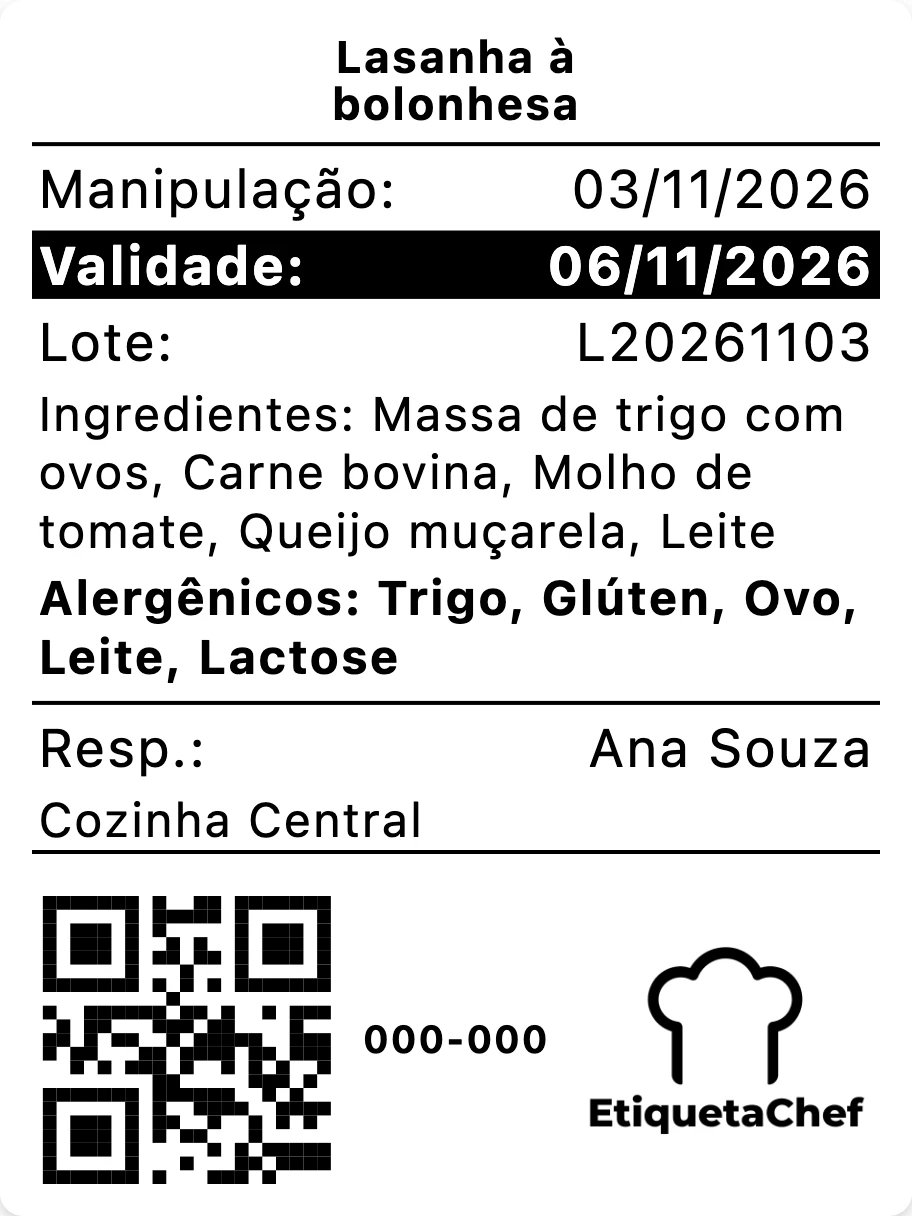
Brazil
ANVISA — RDC 727/2022
Includes wheat, natural latex and the lactose statement. It also shows who prepared the food.

Every country has its own allergen list. EtiquetaChef ships a label template designed for your country’s rules and highlights each product’s allergens. The images below were generated by the app itself.
Same kitchen product, different rules: see what changes on each country’s label.
ANVISA — RDC 727/2022
Includes wheat, natural latex and the lactose statement. It also shows who prepared the food.
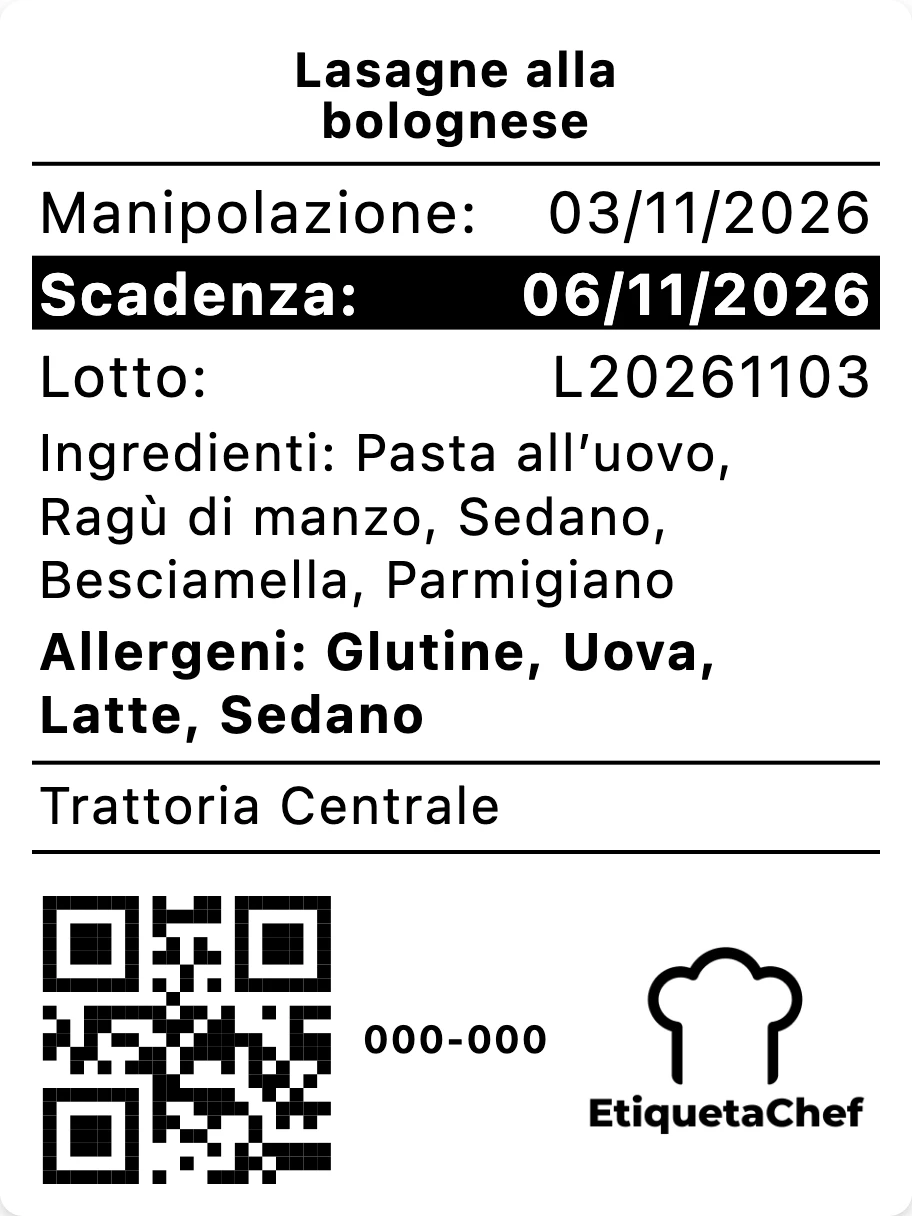
Regulation (EU) 1169/2011, Annex II
The 14 EU allergens, such as celery, mustard, sulphites and lupin, highlighted in bold, with a batch number.
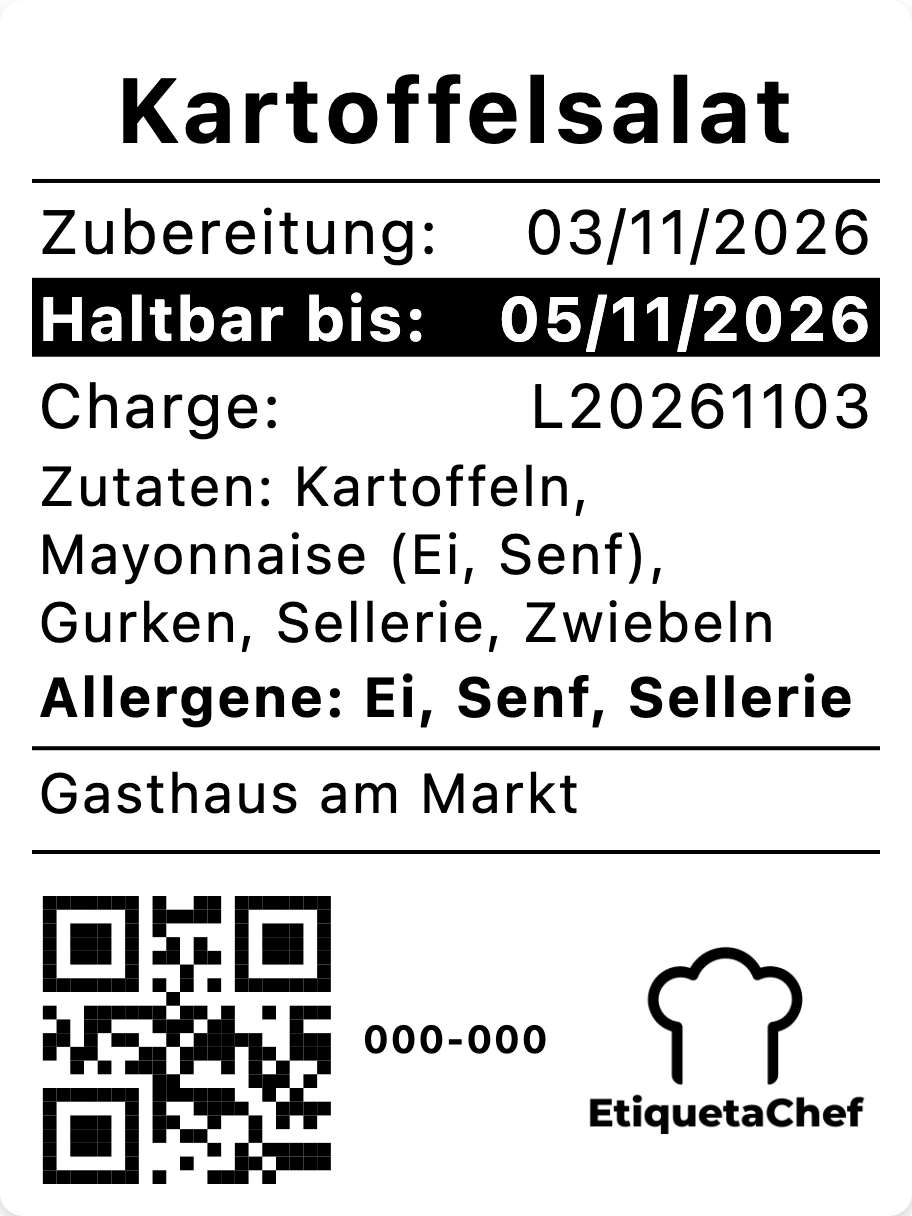
Regulation (EU) 1169/2011, Annex II
The same list of 14, in the establishment’s language. It also applies to Switzerland, the UK, Norway, Iceland and Liechtenstein.
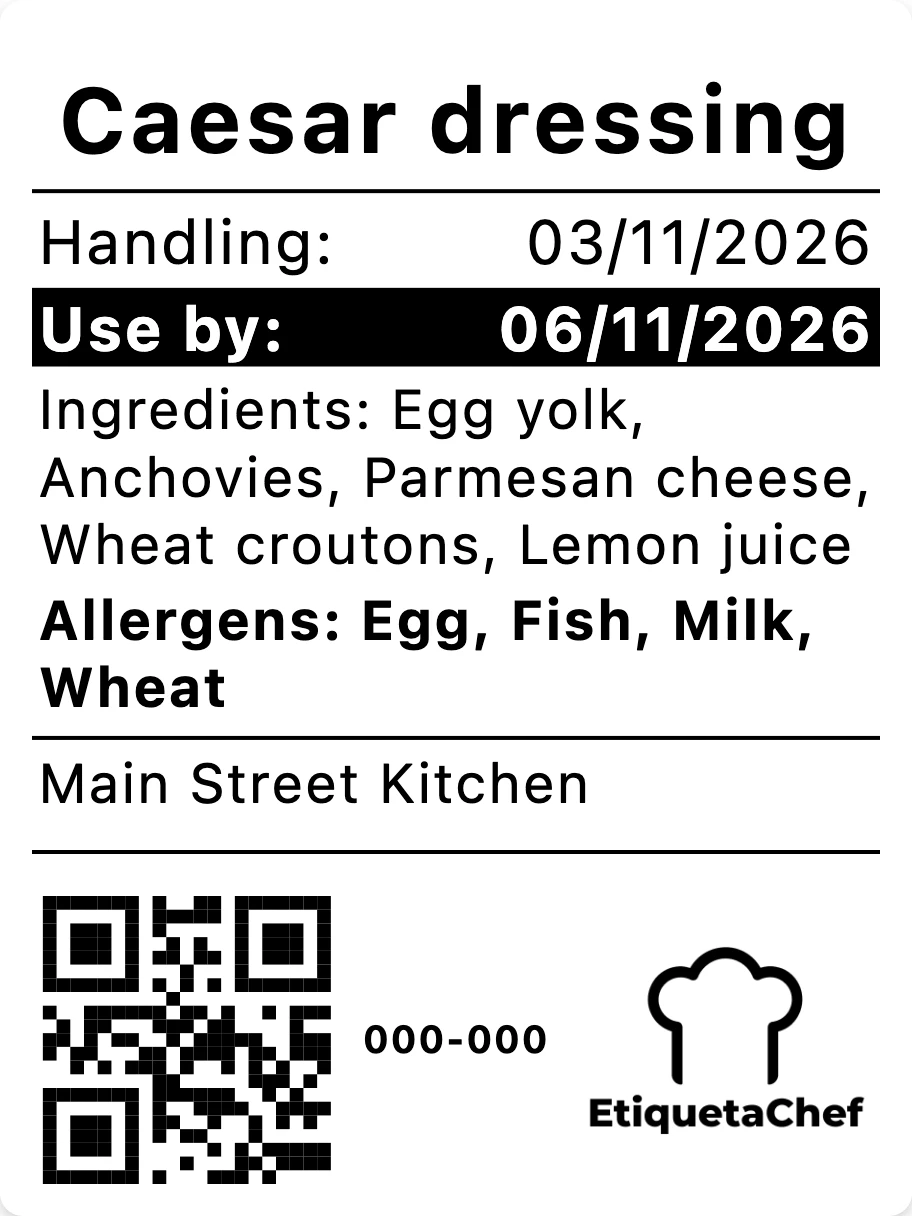
FALCPA + FASTER Act (Big 9)
The 9 major food allergens, including wheat and sesame. The law names wheat, not gluten.
The templates are designed around each country’s allergen list. Labelling compliance remains the responsibility of the establishment and its food safety lead.
Pick a certified printer and the right roll for your label size.
Yes. The full allergen list is always available when you add a product, and you can use any label template or create your own.
Yes. In the template editor you choose the label size and the fields shown, and you can save as many templates as you need.
The US major food allergens (FALCPA, extended by the FASTER Act in 2021 with sesame) name wheat. Other gluten cereals are not on the US list.
Cereals containing gluten, crustaceans, eggs, fish, peanuts, soybeans, milk, tree nuts (walnuts, almonds, hazelnuts etc.), celery, mustard, sesame, sulphur dioxide and sulphites (above 10 mg/kg), lupin and molluscs — the list in Annex II of Regulation (EU) 1169/2011.
Yes. Regulation (EU) 1169/2011 requires allergens to stand out from the other ingredients, for example in bold, and the information must also be available for non-prepacked food, such as food served in restaurants. The EU template already prints allergens in bold.
Because the EU list covers milk and milk products, lactose included. Lactose as a separate statement is a Brazilian requirement (RDC 136/2017), so it only appears on the Brazil template.
Milk, eggs, fish, crustacean shellfish, tree nuts, peanuts, wheat, soybeans and sesame. Sesame was added on January 1, 2023 by the FASTER Act; the other eight come from FALCPA (2004).
FALCPA covers packaged food. In kitchens and restaurants, the FDA Food Code, adopted by the states, expects staff to be able to tell customers about allergens. A label with the Big 9 highlighted helps the team have that information on every container.
The templates follow each country’s allergen list, but they do not replace your food safety lead. Check the product data and the local rules for your establishment.
Talk to a consultant and put together the right plan for your kitchen.
Talk to a consultant